Finding time to exercise feels impossible when your schedule is packed. Research shows nearly half of Americans say they’re too busy to work out at all. The good news: science-backed micro-routines make the best fitness for busy people more achievable than ever.
Best Fitness for Busy People: Why It Matters Now
Time is the number one obstacle standing between most people and consistent exercise. It’s not motivation. It’s not access. It’s the relentless pressure of work, family, and daily demands that leaves little room for a traditional gym session.
The fitness landscape has shifted in response. Short, structured workouts are no longer a compromise. They’re a clinically validated strategy. Research now confirms that even a few minutes of intentional movement can deliver measurable health benefits.
For high performers managing fatigue, weight gain, or early signs of metabolic dysfunction, building a sustainable fitness habit is often the first step toward recovery. Getting this right creates a foundation that supports everything else, from rehabilitation to hormonal health.
What Is the 3-3-3 Rule?
The 3-3-3 workout rule is a structured approach designed for busy schedules. Each session involves 3 workouts per week, 3 exercises per session, and 3 sets per exercise. Sessions run just 20 to 45 minutes, removing decision fatigue for time-strapped professionals.
The science supports this structure. Key findings include:
- Minimal effective dose: A 2025 FAU study in the Journal of Applied Physiology found strength gains plateau after just 1 to 2 hard sets per session, placing 3 sets squarely in the optimal zone
- Strength advantage: A peer-reviewed meta-analysis confirmed 2 to 3 sets per exercise yields 46% more strength than single-set approaches
- Compound focus: Trainer endorsements highlight squats, deadlifts, and rows as the ideal exercise choices for this format
Benefits of Short Workouts
Short workouts aren’t just convenient. They’re genuinely effective. A growing body of research confirms that brief, intense sessions can match or outperform longer, moderate-effort routines for many health outcomes.
The evidence is compelling:
- Disease risk reduction: A UK Biobank study of 96,000+ participants found just 15 to 20 minutes of vigorous activity per week reduced risks of dementia, diabetes, and cardiovascular disease by 29 to 61%
- Weekend warrior effect: A 2024 UK Biobank study of 90,000+ participants found cramming 150 minutes into 1 to 2 days reduced risk across 264 disease conditions as effectively as spreading workouts across the week
- HIIT plus movement breaks: A 2025 American Physiological Society study found combining short HIIT sessions with 2 to 5 minute hourly breaks produced the greatest improvements in cardiorespiratory fitness
- Cognitive sharpness: A PMC study confirmed 10-minute activity breaks sharpen attention and executive function in high-stress professional groups
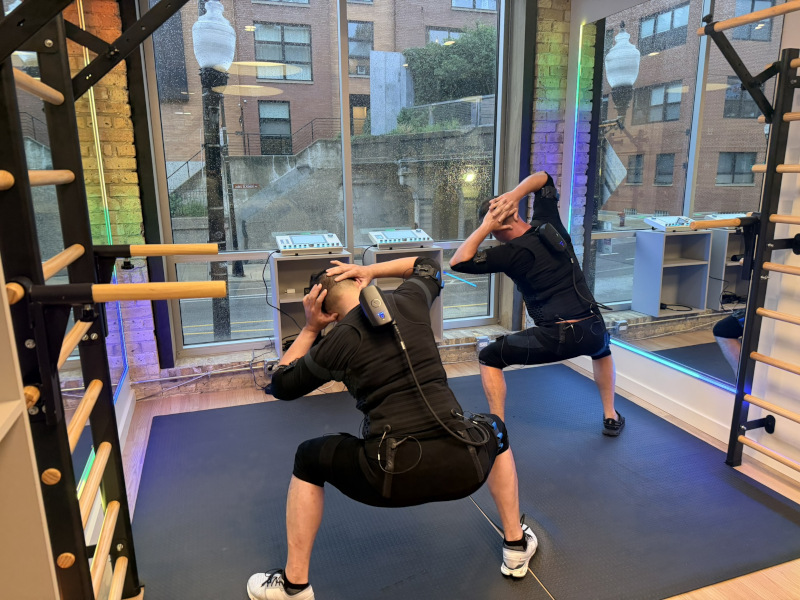
At MedGym, we’ve built our training around this idea. Our CAROL AI bikes use reduced-exertion high-intensity training (REHIT): two all-out 20-second sprints in a ride that takes under 8 minutes, designed to deliver cardio benefits normally tied to much longer sessions. Our EMS (electrical muscle stimulation) sessions work major muscle groups comparable to hours more training in about 20 minutes. Both are paired with physician oversight, so your limited training time goes where it counts.
Implementing the 5-5-5-30 Morning Routine
The 5-5-5-30 routine is one of the most accessible micro-workout formats available. Trainer Melissa Power, founder of Cadence Indoor Cycling, popularized this sub-2-minute circuit: 5 push-ups, 5 squats, 5 lunges per leg, and a 30-second plank. No equipment needed.
Step-by-Step Guide
The routine takes under two minutes and requires zero setup. To complete it:
- Start with 5 push-ups to activate the chest and shoulders
- Move directly into 5 bodyweight squats for lower-body engagement
- Follow with 5 lunges per leg to build single-leg stability
- Finish with a 30-second plank to engage the core
Repeat daily, ideally right after waking, to build momentum before the day begins.
Benefits of Morning Routines
Morning timing matters more than most people realize. According to the ACSM 2025 Fitness Trends Report, 80% of professionals cite “no time” as their primary barrier to working out. Ultra-short morning formats directly solve that problem.
Research shows micro-habits under 5 minutes carry a 70% adherence rate, compared to just 40% for routines lasting 30 or more minutes. Starting small builds the consistency that longer programs rarely sustain.
Habit Stacking for Fitness
Habit stacking attaches a new fitness behavior to an existing daily routine. It’s one of the most effective tools in behavioral science for building lasting exercise habits without relying on willpower alone.
The data shows why it works:
- Higher success rate: Habit stacking shows a 64% higher success rate compared to building exercise habits from scratch
- Stickiness boost: New behaviors stacked onto existing habits are up to 50% more likely to stick than standalone new behaviors
- Workplace impact: Companies using habit-stacking wellness programs reported an 18% boost in productivity and a 12% drop in employee stress after just 3 months
- Frequency gains: Employees who stacked workouts with daily routines showed a 22% increase in weekly exercise frequency versus standalone workout plans
- Habit threshold: Exercising at least 4 times per week for 6 consecutive weeks is required for genuine automatic habit formation
Bodyweight Training Essentials
Bodyweight training is the most practical fitness tool for busy people. It requires no equipment, no commute, and no gym membership. It also delivers real, measurable results for strength and cognitive performance.
Core benefits include:
- Efficient strength gains: A 2025 FAU meta-regression study confirmed that 1 to 2 hard working sets per session delivers near-maximum strength results, with lead author Michael Zourdos noting: “You don’t need lengthy gym sessions… a low dose of training for strength seems to deliver the most efficient results”
- Sustainable muscle growth: A 2025 Lehman College study confirmed muscle growth occurs without constantly increasing intensity or volume, meaning consistent bodyweight sessions 3 times per week can sustainably build muscle
- Top health goal: LifeTime’s 2025 Wellness Survey found building muscle is the top health goal for the third consecutive year, with bodyweight progressions like push-up variations and pistol squats enabling progressive overload without equipment
- Brain health: Research from the University of British Columbia found regular resistance exercise increases hippocampal volume, the brain region responsible for memory and learning
Maximizing Efficiency with Active Commuting
Active commuting turns unavoidable travel time into a fitness opportunity. For busy people who struggle to carve out dedicated workout windows, walking or cycling to work may be the most efficient fitness strategy available.
Benefits of Active Commuting
The health outcomes are striking. A landmark 2024 BMJ Public Health study analyzed data from approximately 250,000 Scottish adults over 18 years. Cyclists who commuted to work had a 47% lower all-cause mortality risk compared to inactive commuters.
The same study found cycling commuters had 24% fewer cardiovascular hospitalizations, 30% fewer cardiovascular prescriptions, and 20% fewer mental health prescriptions compared to those who drove or took public transport. These are meaningful outcomes for anyone managing fatigue or early metabolic dysfunction.
Practical Tips
Walking commuters also benefit significantly. The same BMJ research found 9 to 11% fewer hospitalizations and 7% fewer mental health prescriptions for regular walkers compared to inactive commuters.
A UK government review found that brisk walking for 2.5 hours per week reduces type 2 diabetes risk by 17%. Start with one or two days per week. Even partial active commutes (such as parking further away or exiting transit one stop early) count toward weekly activity totals.
Conclusion
Consistent movement doesn’t require hours at a gym. The research is clear: short, structured workouts built into existing routines deliver real health benefits, from reduced disease risk to improved cognitive performance. The barrier isn’t biology. It’s scheduling.
For high performers dealing with fatigue, weight gain, or metabolic dysfunction, these strategies offer a practical starting point. Whether through a morning micro-routine, habit stacking, bodyweight training, or active commuting, the path to better fitness fits into a busy life. Small steps, done consistently, build lasting results.
If you want a plan built around your schedule, book a MedGym consultation and see what 30 focused minutes can do.
Frequently Asked Questions
How many Americans actually meet exercise guidelines?
Only about 25% of U.S. adults meet both aerobic and strength training guidelines, according to the CDC’s 2025 Early Release Physical Activity Report. Approximately 26% of adults report zero leisure-time physical activity. These numbers highlight a widespread gap between health intentions and actual behavior, making efficient, low-barrier fitness strategies especially relevant for the United States population.
Why do busy people in the United States struggle to exercise consistently?
A OnePoll survey of 2,000 U.S. adults found 48% say they are too busy to exercise at all, and more than 60% are too tired to work out after work. Employed Americans average only about 3 hours of exercise per week. Desk-based fatigue and long work hours are the primary culprits, making morning and commute-based routines the most practical solutions.
What types of short workouts are most effective for building strength?
Bodyweight training with progressive overload is among the most effective options for time-limited individuals. Push-up variations, pistol squats, and pull-up regressions allow consistent strength development without equipment. For those managing hormonal issues like low testosterone or exploring TRT, pairing structured resistance training with medical weight loss support through a program like Balanced Flow’s MedGym can accelerate results significantly.
How does short-burst fitness compare to traditional gym training?
Short-burst formats like HIIT and the 3-3-3 rule produce comparable strength and cardiovascular outcomes to longer sessions for most people. An Ipsos global survey across 29 countries found 58% of people want to exercise more but cite time as the top barrier, ahead of cost and access. Structured micro-workouts remove that barrier without sacrificing meaningful health outcomes.
What are the most popular short workout formats among busy Americans?
According to the OnePoll survey, the top workout formats chosen by busy Americans are running (36%), cardio (33%), free weights (31%), yoga (25%), and spinning (11%). Additionally, 56% of respondents reported that regular exercise boosts work productivity, and 79% say they feel happier when maintaining a consistent fitness routine, reinforcing the performance benefits of even minimal weekly movement.