Most people skip workouts when no one is watching. That’s not a character flaw. It’s human nature. Research consistently shows that training with others changes the equation in ways that solo exercise simply can’t replicate.
Introduction
Exercise adherence is one of the biggest challenges in physical health today. Only 46.9% of U.S. adults meet basic aerobic activity guidelines, according to the CDC. The gap between intention and follow-through is wide, and it costs people their health goals.
Partnered training addresses that gap directly. Whether you’re working with a single accountability partner, a small group, or a structured class environment, the social dimension of exercise changes how hard you push, how often you show up, and how long you stick with it.
The research behind this is substantial. From the Kohler effect to long-term adherence studies, the science of training together reveals why high performers, rehabilitation patients, and everyday athletes all benefit from shared workouts. Understanding these findings helps anyone build a smarter, more sustainable fitness routine.
5 Key Benefits of Working Out with Others
Training alongside others produces measurable advantages across physical performance, mental health, and long-term adherence. The evidence spans peer-reviewed studies, randomized controlled trials, and large-scale surveys.
Key benefits include:
-
Higher completion rates: Research cited by NBC News found that 95% of people who started a weight-loss program with friends completed it, compared to 76% who went solo.
-
Better attendance: A 2025 YMCA study found that 64% of large-group exercisers attended three or more sessions per week, the highest frequency of any exercise format.
-
Reduced stress: Group exercise participants in a 12-week study showed significant reductions in perceived stress and meaningful gains in physical, mental, and emotional quality of life.
-
Lower depression risk: A 2025 PMC study linked regular team training to approximately 28% lower depression risk and 35% reduced social anxiety.
-
Long-term retention: Among long-term gym members, 73% participated in some form of group exercise, suggesting group formats support sustained commitment.
How Working Out with Other People Enhances Results
The performance gains from partnered training aren’t accidental. They’re driven by specific psychological and social mechanisms that researchers have studied in detail. Three stand out as the most consistently documented.
Increased Accountability
Accountability is one of the most powerful forces in behavior change. When someone else depends on your presence, skipping a session or giving subpar effort carries a social cost that solo workouts don’t. That friction matters.
Research on structured accountability shows that committing to a goal with an accountability partner increases the likelihood of achieving it by 65%. Scheduled check-ins can push that success rate even higher. For patients in physical therapy or rehabilitation, this dynamic is especially relevant. Showing up consistently is often the difference between recovery and setback.
Friendly Competition
The Kohler effect describes the motivation gain that occurs when people exercise in a partnered setting where their performance matters to the group. It’s well-documented and surprisingly powerful.
A 2023 meta-analysis of 19 peer-reviewed studies covering nearly 2,000 participants confirmed a statistically significant, large-magnitude motivation gain when people trained in conjunctive partner settings versus alone. In one cycling study, partnered participants persisted an average of 675 seconds longer than solo controls. That’s not a small difference.
Social Support
Social support reduces perceived fatigue and allows greater physical output. This isn’t just motivational theory. It shows up in performance data. It’s another benefit of working out with others.
A 2025 Oxford-linked study found that Parkrun participants with stronger social support networks ran faster 5 km times. The University of Aberdeen found that people who gained a new exercise companion exercised more often, and when that companion was emotionally supportive, frequency increased even further. Encouragement and praise outperformed simply showing up together.
Overcoming Challenges from Working Out with Others
Partnered training isn’t automatically better. The benefits depend on compatibility, structure, and realistic expectations. Several common challenges can undermine the experience if left unaddressed.
Aligning Goals
Mismatched goals are one of the most common reasons partner workouts fail. If one person is training for medical weight loss and the other is focused on athletic performance enhancement, the sessions can feel unfocused for both.
The Partner2Lose randomized controlled trial found that partner-assisted and solo weight-loss programs produced statistically identical average weight loss over 24 months. A partner alone doesn’t guarantee better physical outcomes. Behavioral alignment, meaning shared goals and shared commitment, is what drives results. Start by having an honest conversation about what each person actually wants from the program.
Scheduling Flexibility
Scheduling conflicts are one of the most frequently cited barriers to consistent partner training. Life gets complicated, and rigid arrangements break down fast.
Chicago Athletic Clubs identify social chatting and scheduling mismatches as key causes of longer, less-focused sessions. Building flexibility into the arrangement helps. Consider designating two or three fixed sessions per week while allowing each person to be independent on other days. This preserves accountability without creating dependency.
Fitness Level Compatibility
A significant gap in fitness levels can reduce the motivational benefit for both partners. The Kohler effect is strongest when a partner is only moderately more capable.
Too large a performance gap reduces the motivational benefit of partnered training. A partner who is far less enthusiastic can actually reduce workout productivity. In a structured rehabilitation setting, matching participants by approximate fitness level or goal type produces better outcomes for everyone involved.
Implementing Workouts with Others in Your Routine
Getting the structure right from the start makes partnered training sustainable. Three areas deserve attention before the first session begins.
Finding the Partners or Groups
The right partner or group is more important than the format. A 2022 study found that for women, belonging to an exercise group was significantly associated with higher weekly physical activity and stronger exercise identity, and exercise identity itself strongly predicted activity level.
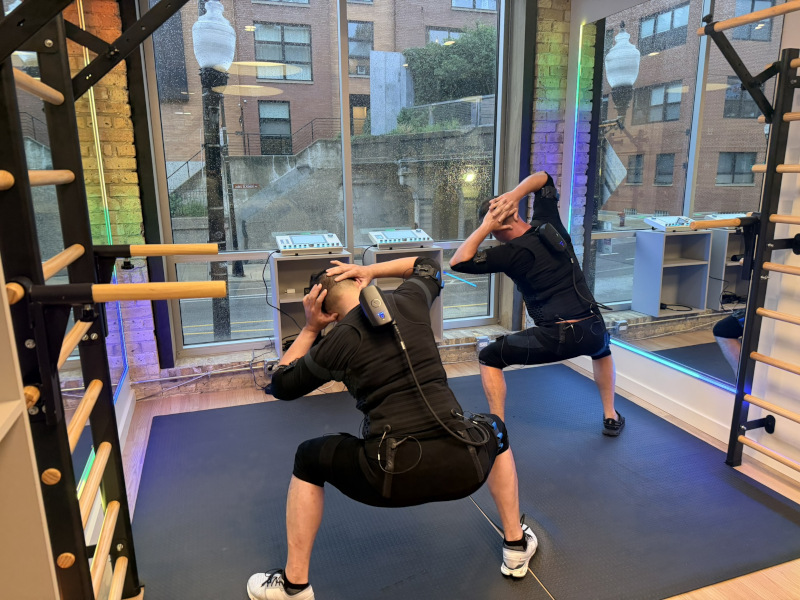
Look for partners through structured environments: group fitness classes, community running clubs, physical therapy programs, or workplace wellness initiatives. Nearly 40% of regular exercisers already participate in group fitness classes, and a Nielsen survey found that more than 85% of group class participants attended their facility at least twice per week specifically for those classes. At the MedGym, private partnered training sessions are designed to motivate and provide accountabilty with activities that allow all participants to work at their own level – the best of all worlds.
Setting Realistic Expectations
Partnered training works best when both people understand what they’re signing up for. Personality plays a role too. A 2025 Frontiers in Psychology study found that people high in extraversion enjoyed high-intensity group sessions most, while others preferred solo formats.
Don’t assume a partner will fix motivation problems that already exist. A partner amplifies effort and consistency. The baseline commitment still has to come from within. Set a trial period of four to six weeks, evaluate honestly, and adjust the arrangement if it isn’t working.
Staying Consistent
Consistency is where partnered training earns its reputation. Couples who enrolled in a fitness program together had only about 8% dropout, compared to roughly 50% dropout among individuals who joined alone.
The University of Aberdeen found that emotional support, specifically encouragement and praise, was more strongly linked to exercise frequency than simply training together. How a partner supports you matters more than their mere presence. Build check-ins, celebrate milestones, and treat the relationship as part of the program itself.
Conclusion
The research on partnered training points in a consistent direction. People who exercise with others show up more often, push harder, and stay with their programs longer. The psychological mechanisms behind these outcomes, accountability, competition, and social support, are well-documented and clinically meaningful.
For anyone managing fatigue, working through rehabilitation, or trying to build lasting fitness habits, the social dimension of exercise is worth taking seriously. Partnered training isn’t a shortcut. It’s a structure that makes the work more sustainable, and for many people, it’s the factor that finally makes the difference.
Frequently Asked Questions
Do workout partners actually help with weight loss in the United States?
Partners improve adherence far more reliably than they improve the scale. The Partner2Lose randomized controlled trial found statistically identical average weight loss between partner-assisted and solo groups at 24 months. However, adherence tells a different story: couples who enrolled in fitness programs together showed roughly 8% dropout, compared to about 50% for solo participants. In the United States, where gym dropout rates peak in February, that adherence advantage is significant.
How does exercising with others affect mental health?
Group exercise produces measurable mental health benefits that solo training doesn’t consistently replicate. A peer-reviewed study found that group fitness participation increases adherence to physical activity by approximately 45%, and a 2025 Frontiers in Psychology study found that peer support partially mediates the link between exercise frequency and mental health outcomes. For patients managing anxiety, fatigue, or hormonal dysfunction, the social component of structured group training adds a meaningful layer of support.
Can a workout partner influence someone who isn’t exercising at all?
Yes, and the effect is well-documented. A University of Connecticut study found that approximately one-third of untreated partners, spouses or partners who were not enrolled in any program, still lost 3% or more of their body weight within six months when their significant other was actively working on weight loss. This ripple effect suggests that the influence of a committed training partner extends beyond the gym floor.
Are virtual or app-based workout partners as effective as in-person partners?
Virtual partners can produce real motivation gains, but they don’t match the impact of human presence. Research using software-generated partners in the Kohler paradigm found meaningful increases in persistence, though human partners elicited larger gains in effort and endurance (p less than 0.05). For high performers or athletes focused on athletic performance enhancement, in-person training relationships tend to produce stronger results than digital alternatives alone.
How do I know if a workout partner is the right fit for my fitness level?
The Kohler effect works best when a partner is only moderately more capable than you. Too large a gap in either direction reduces the motivational benefit for both people. A small four-week controlled study comparing individual and partnered circuit training found no significant differences in motivation or fitness outcomes between groups, highlighting that compatibility matters more than simply having a partner. A brief trial period of three to four weeks is a practical way to assess fit before committing to a long-term arrangement.