Most Americans want to exercise more but can’t find the time. Only 47.2% of U.S. adults meet basic aerobic activity guidelines, according to the CDC. The CAROL bike changes that equation. With science-based training Chicago high performers are using it to get real results in as little as 5 minutes.
Science-Based Training Chicago: Why REHIT Is Changing Fitness
Time is the most common reason people skip exercise. Traditional cardio demands 30 to 45 minutes per session. For busy professionals, athletes, and anyone managing fatigue or weight gain, that’s often not realistic.
Reduced-Exertion High-Intensity Interval Training (REHIT) delivers measurable cardiovascular gains in a fraction of that time. It’s grounded in peer-reviewed research and increasingly available through technologically advanced gyms and rehabilitation settings across the country.
Chicago’s fitness landscape is shifting toward evidence-based protocols. Providers focused on athletic performance enhancement, medical weight loss, and rehabilitation are adopting REHIT because the science supports it. Understanding how it works helps you decide if it fits your goals.
What Is REHIT Training?
REHIT on the CAROL bike is a time-efficient protocol built around two all-out sprint efforts. Each sprint lasts just 10-20 seconds, making the total hard effort 40 seconds per session.
Key facts about REHIT include:
-
Session length: About 5-8 minutes total, including warm-up and cooldown
-
Sprint structure: Two all-out efforts (10-20 sec each) with a 3-minute recovery between them
-
Frequency: As few as two sessions per week produces measurable results
-
Time barrier: Perceived lack of time is the most cited barrier to exercise, per the 2024 REHIT narrative review
-
Comparison to HIIT: Traditional HIIT uses 4 to 10+ intervals of 30 seconds to 4 minutes; REHIT uses only 2 to 3 maximal efforts
Benefits of REHIT Training
REHIT produces clinical-grade cardiovascular improvements in a short time. The research backing it is strong and growing.
“Each 1-MET increase in VO2max is linked to a 10 to 17% lower all-cause mortality risk.” – American College of Cardiology (acc.org)
Evidence-based benefits include:
-
VO2max improvement: Six weeks of REHIT improves VO2max by an average of 10%, per the CAROL Bike science page summarizing the Metcalfe and Vollaard 2024 review
-
Blood pressure: REHIT produces a threefold greater reduction in systolic blood pressure versus moderate-intensity training
-
Diabetes risk: An 8-week REHIT study reported approximately a 62% reduction in estimated type 2 diabetes risk based on insulin sensitivity markers
-
Mental health: A 2025 burpee-based REHIT study found large reductions in stress, anxiety, and depression alongside physical gains
-
Adherence: 89% of unsupervised REHIT sessions were completed in a workplace-based cycling study
How REHIT and CAROL Works
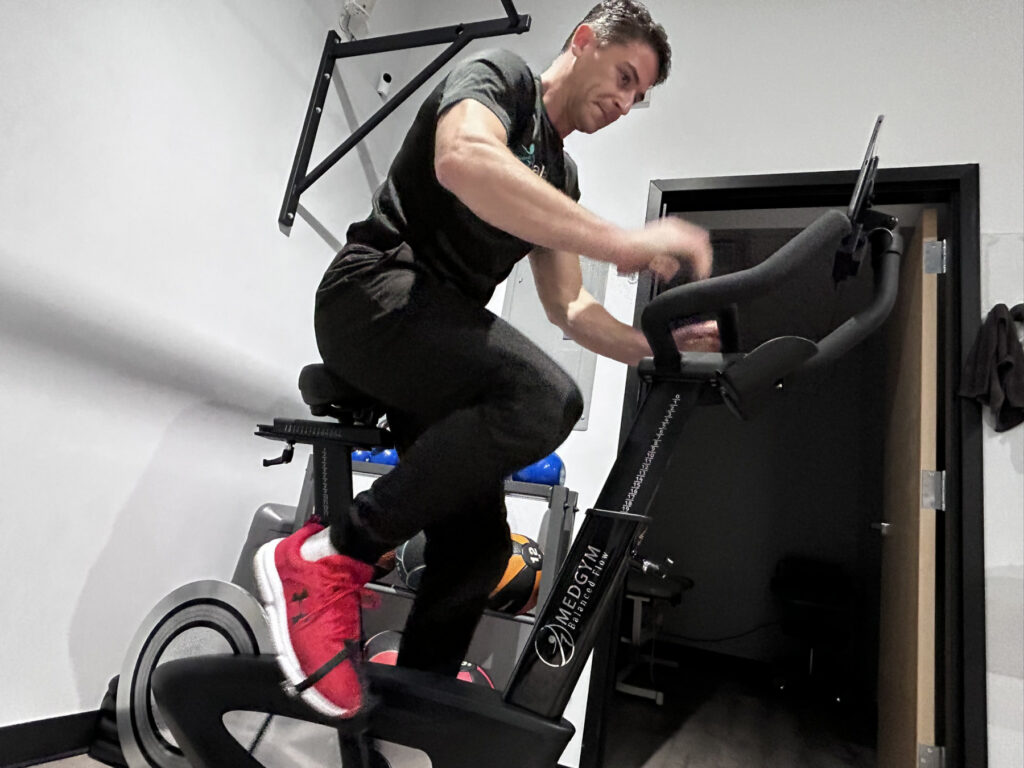
The CAROL bike brings lab-grade REHIT into a home or medgym setting. It uses AI-driven resistance control to replicate the exact physiological stimulus used in clinical research.
Core Components
The CAROL protocol follows a precise structure. A brief warm-up leads into Sprint 1 (20 seconds all-out), followed by a 3-minute recovery, then Sprint 2 (20 seconds all-out), and a cooldown. Total session time runs approximately 5 to 8 minutes depending on how quickly you want to finish the ride.
This structure is not arbitrary. It mirrors the protocols used in peer-reviewed REHIT trials, making it one of the few consumer devices with a direct link to published science.
The CAROL Technology
CAROL’s “Instant Resistance” system applies precise resistance at the exact moment each sprint begins. This removes the need for manual adjustment and makes sure the effort is truly maximal, which is the physiological trigger for adaptation.
According to CAROL Bike Science, users see an average 12% improvement in VO2max in 8 weeks with three sessions per week. The company describes this as delivering the same health and fitness results as a 45-minute run in just 5 minutes.
Data Flow
CAROL tracks each session and feeds data back to the rider. Metrics include resistance levels, heart rate response, and sprint output. This feedback loop supports the kind of structured, progressive overload that high performers and rehabilitation patients both need.
For Chicago providers integrating CAROL into physical therapy or athletic performance enhancement programs, this data also supports clinical documentation and outcome tracking.
Practical Applications in Chicago
Science-based training options in Chicago are expanding, and REHIT fits naturally into several settings. With 53% of U.S. adults not meeting exercise guidelines, time-efficient protocols address the city’s dominant fitness barrier directly.
Chicago applications include:
-
MedGym integration: CAROL bikes fit into medical gym environments alongside EMS and other evidence-based modalities for high performers managing fatigue or weight gain
-
Rehabilitation settings: Physical therapy and postnatal care programs can use REHIT-style protocols for low-time, high-impact cardiovascular rehabilitation
-
Cardiac rehab: Hospital-based programs in the Chicago metro increasingly implement HIIT and REHIT protocols modeled on published research, with VO2max testing and HRR-based interval prescription
-
Corporate wellness: REHIT’s 8-minute format fits easily into workday schedules, supporting adherence among time-pressed professionals
Challenges and Considerations
REHIT is not a perfect fit for everyone. Several real limitations deserve attention before starting a program.
“Real-world adherence to HIIT programs runs at approximately 63%, meaning about 37% of participants drop out even with a time-efficient format.” – CAROL Bike (carolbike.com)
Common challenges include:
-
Variable response: Only about 50% of individuals achieve a clinically meaningful VO2max improvement from REHIT; gains are strongest in sedentary or low-fitness populations
-
Active populations: A 2024 trial in recreationally active middle-aged men found a single REHIT session did not meaningfully improve 24-hour glucose control
-
Short trial periods: Most REHIT studies run only 6 to 8 weeks with small samples, leaving long-term outcomes largely unknown
-
Intensity perception: Participants report negative perceptions when sprint duration increases from 15 to 20 seconds, making intensity a real barrier for older or deconditioned individuals
-
Clinical clearance: Anyone with cardiovascular dysfunction, arrhythmias, or uncontrolled hypertension should obtain medical clearance before attempting maximal sprints
Cost of REHIT Training in the US
REHIT training costs vary depending on whether you choose a home device, a studio, or a clinical setting. Here is the breakdown:
-
CAROL Bike purchase: Approximately $2,595 to $2,795 in the United States, per carolbike.com
-
Home membership: $19.99 per month, covering up to 8 household riders
-
Premium membership: $59.99 per month, adding personal coaching, Les Mills+ access, and priority support
-
First-year total cost: Approximately $3,100 to $3,300 including bike, accessories, and membership
-
Chicago 1-on-1 science-based training: $70 to $150 per session; River North and Lincoln Park studios typically run $90 to $150
-
Small-group science-based training: $25 to $60 per person per session, making it the most accessible entry point
Conclusion
REHIT represents a meaningful shift in how science-based training professionals and patients in Chicago approach cardiovascular fitness. The research is clear: short, maximal-effort sessions produce real gains in VO2max, blood pressure, and metabolic health, often in less time than a lunch break.
For providers at Balanced Flow and similar wellness centers, integrating REHIT into physical therapy, medical gym, and athletic performance enhancement programs gives patients a credible, evidence-backed option. Whether the goal is rehabilitation, medical weight loss, or peak performance, the science supports making REHIT part of the conversation.
Frequently Asked Questions
How much does a CAROL Bike cost in the United States?
The CAROL Bike is priced at approximately $2,595 to $2,795 in the United States, with a required home membership at $19.99 per month. A Premium membership adds personal coaching and additional content for $59.99 per month. Commercial memberships for gyms and clinics start at $49 per month, making it a viable option for medical gym and physical therapy settings looking to offer science-based training.
Is REHIT training available in Chicago?
Yes. Chicago offers several science-based training options compatible with REHIT principles. Discover Strength in River North uses exercise physiologist-designed protocols backed by peer-reviewed research. Hospital-based cardiac rehabilitation programs and university-affiliated exercise physiology labs in the metro area also implement REHIT-style interval protocols. Only 24.2% of U.S. adults meet both aerobic and muscle-strengthening guidelines, making Chicago’s growing evidence-based fitness sector especially relevant.
How quickly does REHIT improve cardiovascular fitness?
Measurable VO2max improvements appear in as little as 6 weeks. A pre-registered randomized controlled trial using low-volume sprint interval training found VO2peak improved by approximately 16% over 6 weeks, with 94% of participants improving. Results are strongest in sedentary or previously inactive individuals. Those managing fatigue, hormonal imbalances from HRT or TRT, or weight gain from metabolic dysfunction may see particularly meaningful gains.
How does REHIT compare to Zone 2 cardio?
CAROL’s science summary, citing 2024 research, states REHIT delivers superior health and fitness benefits in 90% less time compared to Zone 2 training. However, independent reviewers note that comparative evidence is still limited to small trials and surrogate markers like VO2max rather than long-term clinical outcomes. For high performers and rehabilitation patients, REHIT offers a practical time advantage. Zone 2 may still complement REHIT for those with specific endurance goals.
Can I do REHIT without a CAROL Bike?
Yes. A 2025 study demonstrated that a 40-second, equipment-free burpee-based REHIT protocol produced significant improvements in physical fitness and mental health in free-living conditions. The key stimulus is maximal effort, not the equipment. That said, devices like the CAROL Bike provide AI-controlled resistance and session tracking that make the protocol more precise and easier to replicate consistently, which matters in clinical and medical gym settings.