Short answer: Knee pain that shows up without an injury is usually caused by load the knee can’t handle — not damage to the knee itself. The most common drivers are weak or poorly timed hip muscles, stiff ankles, sudden jumps in activity, extra body weight, and early joint changes. Less often, the pain isn’t coming from the knee at all: it’s referred from the hip or a nerve in the lower back. The good news is that almost all of these are fixable once you find which one is yours.
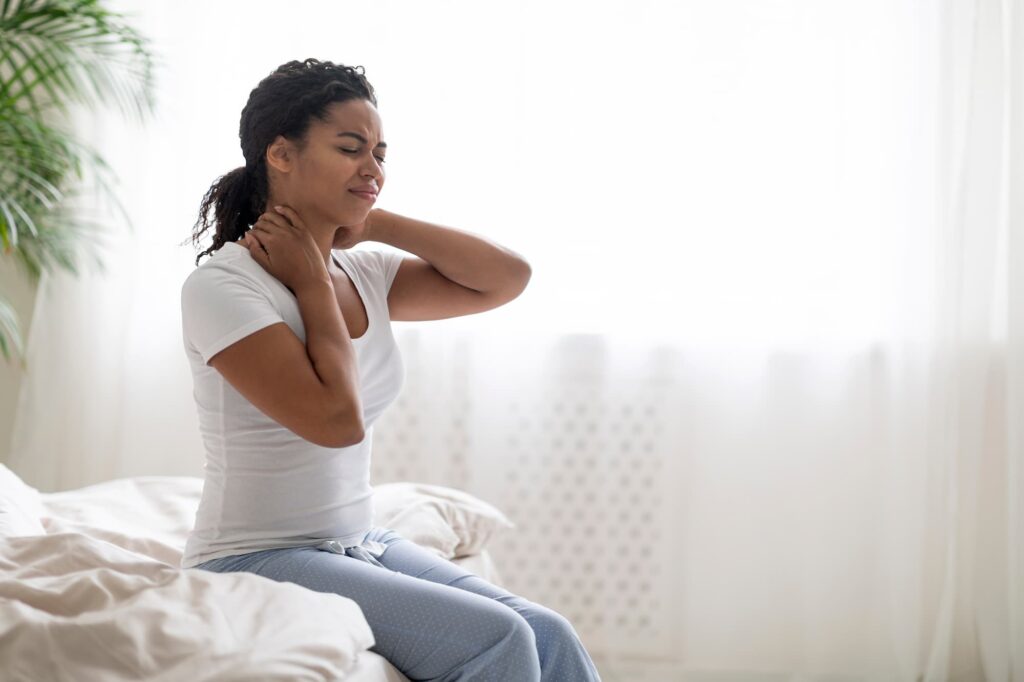
I hear it every week: “I didn’t do anything. It just started hurting.” There was no fall, no twist, no pop. You just noticed it on the stairs one morning, or at the end of a run, or getting up from your desk — and now it won’t go away.
In about twelve years of treating knees at Balanced Flow, the Chicago clinic I founded, I’ve learned that “no injury” knee pain is the most common kind there is, and also the most misunderstood. If you haven’t read it yet, my overview of what causes knee pain covers the big picture. This post goes one layer deeper into the pain that seems to come from nowhere.
Why does my knee hurt if I didn’t injure it?
Because pain doesn’t require an injury. It requires the tissue to be asked to do more than it’s currently prepared for. Tendons, cartilage, and the joint lining all have a capacity — a ceiling of load they can tolerate. When the demand on your knee creeps above that ceiling, day after day, the tissue gets irritated and starts sending signals. No single moment broke anything. The math just stopped adding up.
That’s why this kind of pain is so common. The most frequent version, patellofemoral pain (pain around or behind the kneecap), has an estimated annual prevalence of about 22.7% in the general population and nearly 29% in adolescents.1 That’s not a rare condition. That’s roughly one in five people dealing with it in any given year — most of whom never injured anything.
What are the most common causes of knee pain without injury?
1. Weak or lazy hip muscles
This is the one I find most often, and the one that gets missed most often. Your glutes — especially the muscles on the side and back of the hip — control where your thigh bone goes when you squat, climb stairs, or land from a step. When they’re weak or slow to fire, the thigh drops and rotates inward, and the kneecap ends up tracking under load it wasn’t built for.
The research here is strong. A 2023 systematic review and meta-analysis found that strengthening the hip abductors and lateral rotators improved pain and function in patellofemoral pain, and in most trials it outperformed the traditional approach of only strengthening the quads.2 The international consensus on patellofemoral pain backs this up: the best-supported treatment is exercise that combines hip-focused and knee-focused work.3 Translation — when your knee hurts, the fix is often at your hip.
2. Stiff ankles and feet that don’t absorb force
If your ankle can’t bend forward well — common after old sprains, years in dress shoes, or simply never training it — your body finds that motion somewhere else. Usually the knee caves in or the heel lifts early, and the knee absorbs force the ankle was supposed to handle. Flat, collapsing arches do something similar. These are quick to test and very trainable.
3. Doing too much, too soon
This is the classic overuse picture: you signed up for a half marathon, started a new class, added heavy squats, or went from zero to hiking every weekend. Tissue adapts to load, but it adapts on its own timeline — tendons and cartilage are slower than muscle. Ramp up faster than they can keep pace and you get patellar tendon pain, runner’s knee, or IT band irritation. Nothing tore. It’s simply overwhelmed. The answer is almost never total rest; it’s adjusting the dose and building capacity back up.
4. Sitting most of the day
Long hours in a chair do two things to knees. The bent position keeps steady pressure on the kneecap (some people know this as “moviegoer’s knee” — the ache after sitting through a film). And over time, sitting shortens the hip flexors and quiets the glutes, which feeds straight back into cause number one. A lot of my executive clients in Chicago don’t have a knee problem so much as a desk problem showing up in their knees.
5. Carrying extra body weight
Every step multiplies your body weight through the knee. In a well-known study from Wake Forest, each pound of weight lost was associated with a roughly four-pound reduction in load on the knee per step.4 Spread across thousands of steps a day, that’s an enormous difference. This isn’t about judgment — it’s mechanics. For some people, a modest change in body composition does more for their knees than any treatment on the table.
6. Early joint changes (the “it’s just arthritis” explanation)
After 40, an X-ray or MRI will often show some cartilage thinning or wear. That’s real, and it can contribute. But here’s what most people aren’t told: imaging is a weak predictor of pain. A systematic review of population studies found that among people with knee pain, anywhere from 15% to 76% had arthritis on X-ray. Among people whose X-rays showed arthritis, 15% to 81% had pain.5 Those ranges are enormous, and that’s the point: what shows up on an image doesn’t reliably tell you whether a knee will hurt. Plenty of people have painful knees with clean X-rays, and plenty have “arthritic” X-rays and no pain at all. The authors’ conclusion was that knee X-rays shouldn’t be used in isolation to judge a painful knee. So if you’ve been told “it’s just arthritis, nothing to do,” that’s rarely the full story. How you load the joint matters at least as much as what the picture looks like.
7. Pain referred from your hip or lower back
Sometimes the knee is completely healthy and the problem is upstream. A degenerating hip can send pain to the knee — in one study of patients waiting for hip replacement, 47% had pain below the knee, even though most orthopedic trainees surveyed believed hip pain doesn’t travel that far.6 A pinched nerve in the lower back can do the same: in patients with an L3 nerve root problem, 80% reported pain or numbness at the inside of the knee.7 If your knee pain came out of nowhere, doesn’t change much when you move the knee itself, or comes with back, buttock, or groin symptoms, this needs to be ruled out. I break this down fully in can sciatica cause knee pain?
Could it be something more serious?
Usually not — but a few causes of non-injury knee pain need prompt medical attention rather than a rehab plan. Get seen quickly if your knee is hot, red, and swollen (especially with fever), if swelling came on fast with no explanation, if you can’t bear weight, or if you have pain in several joints along with morning stiffness that lasts more than an hour. These can point to infection, gout, or an inflammatory arthritis, and they’re handled differently. Part of a proper assessment is making sure nothing like this is hiding underneath.
How do you figure out which cause is yours?
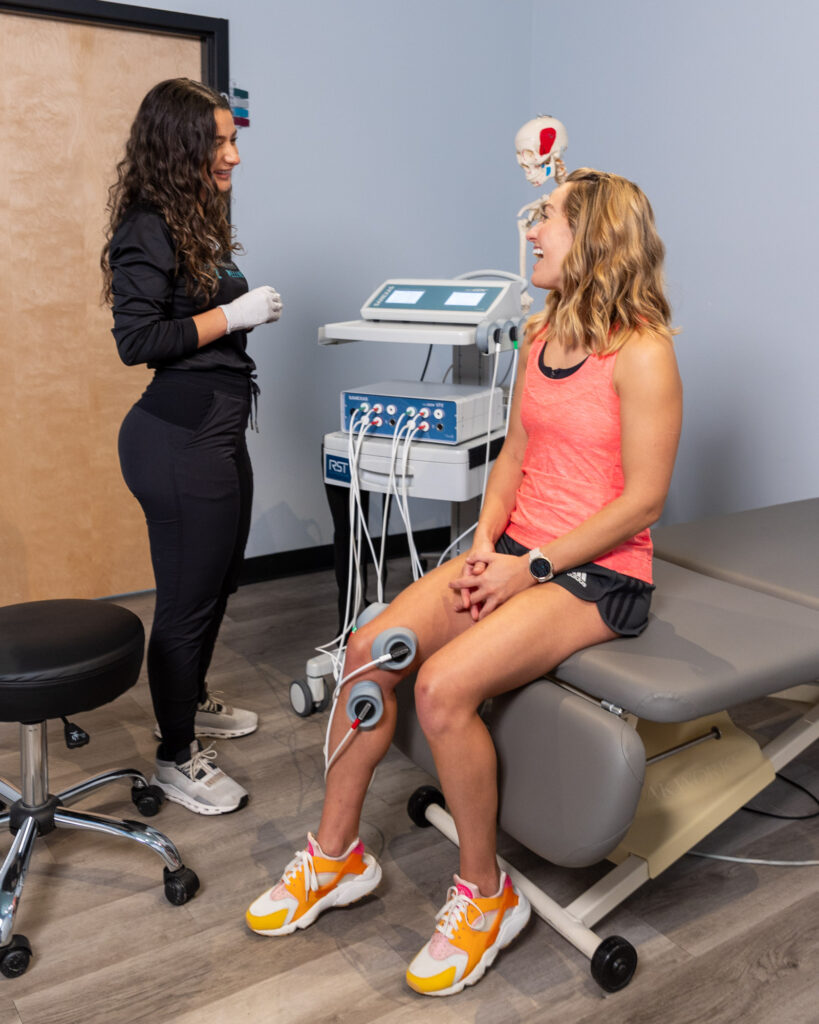
Not by guessing, and not from a single scan. When someone comes to us with knee pain and no injury, we look at the whole chain. We watch you squat, step down, balance on one leg, and walk. We test hip strength and timing, ankle mobility, and foot mechanics. We check whether the pain changes when we load the knee versus the hip or the lower back. And we talk through what changed in your life in the weeks before it started — new training, new job, more sitting, a weight change.
Usually the picture gets clear fast. Most people have one primary driver and one or two contributors. Once those are named, the plan is specific: build the hip strength that isn’t there, restore the ankle motion you’re missing, adjust training load, and retrain the movement pattern so the knee stops absorbing what it shouldn’t.
Where does regenerative therapy fit?
For most non-injury knee pain, mechanics and strength do the heavy lifting. But we’re not opposed to regenerative therapy at Balanced Flow — we use it. If a knee isn’t responding to physical therapy the way it should, or we want to accelerate a rebuild that’s already working, regenerative options can be a real asset. The key is sequence: it’s an accelerator layered on top of fixing the load, not a replacement for it.
The bottom line
“I didn’t do anything” is almost never the end of the story. Knee pain without injury is your body telling you the load on that joint has outgrown its capacity — usually because of what’s happening at the hip, the ankle, your training, or your daily habits. Find the driver, and the knee usually follows.
If you’re in Chicago and your knee started hurting for no clear reason — and hasn’t stopped — that’s exactly what we figure out at Balanced Flow. Book a consult and let’s find the real cause.
Frequently asked questions
Can knee pain without injury go away on its own?
Sometimes, if the cause was a short spike in activity that you’ve since backed off. But if the underlying driver — weak hips, stiff ankles, too much sitting — is still there, the pain usually returns when you go back to normal activity. Recurring pain is the signal that the cause hasn’t been addressed.
Why does my knee hurt when I go up and down stairs?
Stairs, especially going down, put high load on the kneecap and depend heavily on hip control. Pain on stairs is a hallmark of patellofemoral pain and very often improves with targeted hip and quad strengthening.
Why does my knee hurt after sitting for a long time?
Sitting with the knee bent keeps steady pressure on the kneecap, and long hours in a chair weaken the glutes and tighten the hip flexors. Both feed knee pain. Getting up regularly and strengthening the hips usually helps.
Can my back cause knee pain?
Yes. Irritation of a nerve root in the lower back — particularly the L3 or L4 level — can produce pain at the front or inside of the knee even when the knee itself is healthy. Hip arthritis can do the same.
When should I see someone for knee pain that started on its own?
If it hasn’t improved in two to three weeks, keeps coming back, or limits your training or daily life, get it assessed. See a doctor promptly for a hot, red, swollen knee, fever, inability to bear weight, or pain in multiple joints.
References
1. Smith BE, et al. Incidence and prevalence of patellofemoral pain: A systematic review and meta-analysis. PLoS One. 2018;13(1):e0190892. doi:10.1371/journal.pone.0190892
2. Alammari A, et al. Effect of hip abductors and lateral rotators’ muscle strengthening on pain and functional outcome in adult patients with patellofemoral pain: A systematic review and meta-analysis. Journal of Back and Musculoskeletal Rehabilitation. 2023;36(1):35-60. doi:10.3233/BMR-220017
3. Collins NJ, et al. 2018 Consensus statement on exercise therapy and physical interventions (orthoses, taping and manual therapy) to treat patellofemoral pain. British Journal of Sports Medicine. 2018;52(18):1170-1178. doi:10.1136/bjsports-2018-099397
4. Messier SP, et al. Weight loss reduces knee-joint loads in overweight and obese older adults with knee osteoarthritis. Arthritis & Rheumatism. 2005;52(7):2026-2032. doi:10.1002/art.21139
5. Bedson J, Croft PR. The discordance between clinical and radiographic knee osteoarthritis: a systematic search and summary of the literature. BMC Musculoskeletal Disorders. 2008;9:116. doi:10.1186/1471-2474-9-116
6. Khan AM, et al. Hip osteoarthritis: where is the pain? Annals of the Royal College of Surgeons of England. 2004;86(2):119-121. doi:10.1308/003588404322827518
7. Kido T, et al. Clinical diagnosis of upper lumbar disc herniation: Pain and/or numbness distribution are more useful for appropriate level diagnosis. Journal of Orthopaedic Science. 2016;21(4):419-424. doi:10.1016/j.jos.2016.03.003