Short answer: Yes — a chiropractor can help with knee pain, but the kind of chiropractor matters. Hands-on joint work (manipulation and mobilization of the knee, hip, ankle, and lower back) can reduce pain and improve motion in the short term. Lasting results come when that hands-on care is combined with targeted strengthening and movement retraining. A chiropractor who only adjusts will usually give you temporary relief. One who adjusts and rehabs can actually fix the problem.
I’m a chiropractor, so I have a bias here — and I’ll be upfront about it. I founded Balanced Flow here in Chicago and have spent about twelve years treating knees. Early on, I saw a pattern: adjustments alone made people feel better, and then a lot of them came back. That’s why our team now combines hands-on care, physical therapy, and medical support under one roof.
So let’s talk honestly about what the evidence says chiropractic care can and can’t do for knees — and what to look for if you go that route.
Do chiropractors treat knees, or just backs?
Most people think of chiropractors as back-and-neck specialists, and that’s where the bulk of the research is. But chiropractic training covers the whole musculoskeletal system, and many chiropractors treat extremities — knees, hips, ankles, shoulders — every day. Knee problems are a natural fit because, as I explain in what causes knee pain, the knee is usually the victim of what’s happening at the hip, ankle, or lower back. A clinician trained to assess the whole chain is well positioned to find that.
What does a chiropractor actually do for knee pain?
A good knee visit should include more than a quick adjustment. Typically it involves:
Assessment of the whole chain. Watching you squat, step down, balance, and walk. Testing hip strength, ankle mobility, and how your pelvis and lower back move. Ruling out referred pain from the spine or hip.
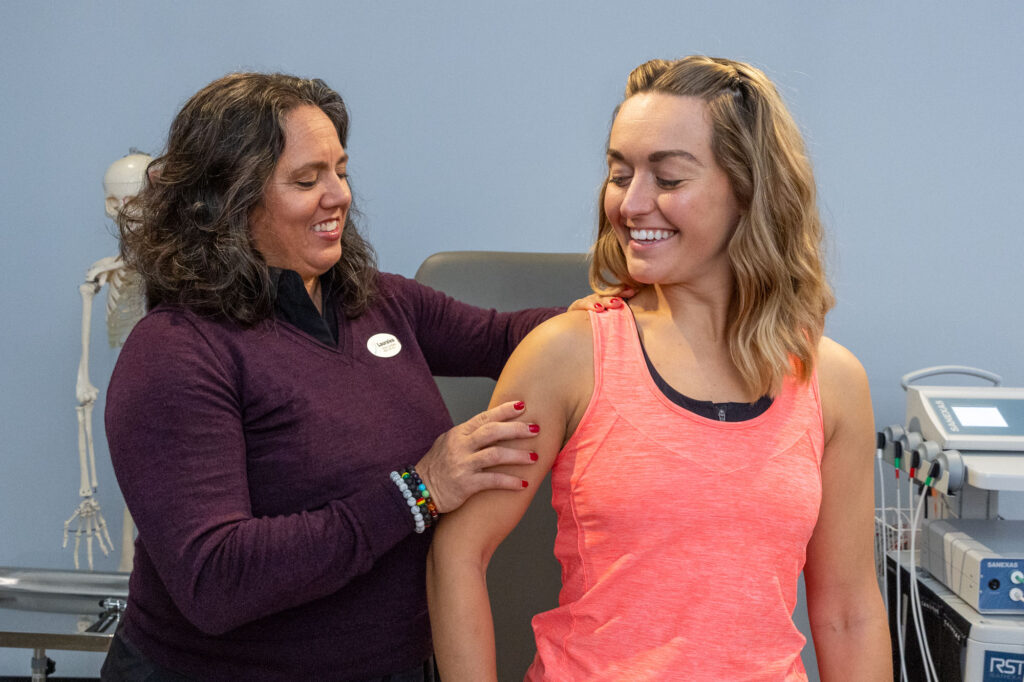
Joint manipulation and mobilization. Gentle, specific techniques to restore motion at the knee itself (including the kneecap and the small joint on the outside of the knee), the hip, the ankle, and the lumbar spine and pelvis.
Soft tissue work. Addressing tight or overactive muscles around the hip and thigh that change how the knee tracks.
Exercise and movement retraining. The part that makes the results stick — strengthening the hips and quads, restoring ankle motion, and retraining how you load the knee.
What does the research say about chiropractic care for knee pain?
The honest summary: hands-on treatment helps, especially early, and it works best as part of a plan built around exercise.
Manual therapy reduces knee arthritis pain. A 2024 meta-analysis of 25 randomized trials with nearly 2,400 patients with knee osteoarthritis found that manual therapy reduced pain compared with usual care, with no serious adverse events reported.2 The quality of many included studies was limited, so I hold that finding loosely — but the direction is consistent.
It adds to exercise in the short term, not the long term. A 2022 review in the Journal of Orthopaedic & Sports Physical Therapy looked at 19 trials comparing manual therapy plus exercise against the same exercise alone in knee and hip osteoarthritis. Manual therapy added benefit for pain in the short term — but there was high-certainty evidence it added nothing in the long term.1 That’s a really useful finding. It tells you the hands-on work is a door-opener: it calms pain and restores motion so you can do the work that creates lasting change.
Adjusting the lower back can change how knee muscles fire. In a randomized, sham-controlled trial of athletes with kneecap pain, a single lumbopelvic manipulation led to earlier and stronger activation of the glute medius and the inner quad (VMO), along with less pain on a step-down test, compared with a sham.4 Those are exactly the muscles that control knee tracking — which is why I often treat the pelvis and lower back in someone whose complaint is their knee.
But on its own, it’s not enough. The 2018 international consensus statement on patellofemoral pain recommends exercise therapy — especially combining hip- and knee-focused exercise — and specifically does not recommend knee, kneecap, or lumbar mobilization used in isolation.3 Hip strengthening, on the other hand, consistently improves pain and function in these patients.6
Hands-on care plus exercise beats a cortisone injection. In a randomized trial published in the New England Journal of Medicine, patients with knee osteoarthritis who received physical therapy — a program combining manual therapy with exercise — had less pain and disability at one year than patients who got a cortisone injection.5
Put all of that together and the picture is clear. Manipulation and mobilization are valuable tools. They’re most valuable when they’re used to unlock a strengthening and movement plan, not to replace one.
When can a chiropractor help the most?
In my experience, chiropractic-style care is especially useful for knee pain when:
The hip, ankle, or pelvis is stiff and the knee is compensating. Restoring motion upstream or downstream takes pressure off the knee.
The pain is actually coming from the lower back. Nerve irritation in the lumbar spine can show up as knee pain. A randomized double-blind trial found that chiropractic manipulation relieved radiating leg pain from disc protrusions significantly better than simulated manipulation — 55% of patients became free of radiating pain versus 20% with the sham.7 If your knee pain is really a back problem, treating the knee won’t solve it. More on that in can sciatica cause knee pain?
The knee is stiff or achy with early arthritis. Mobilization can improve range of motion and comfort enough to make strengthening possible.
Pain is high and you need a window. Calming things down early helps you get through the first few weeks of rehab.
When is a chiropractor not the right first stop?
Some knee problems need imaging, a medical workup, or a surgical opinion first. If your knee locks or gives way, swelled up fast after a twist or pop, is hot and red, or you can’t bear weight, get it properly evaluated before anyone manipulates it. A responsible chiropractor will screen for these and refer out when appropriate.
How to choose a chiropractor for knee pain
Here’s what I’d look for, and what I’d be wary of.
Good signs: a thorough movement assessment on the first visit; treatment of the hip, ankle, and back, not just the knee; exercises you’re expected to do, progressed over time; clear goals and a defined plan with a finish line; and willingness to coordinate with physical therapy or medical care.
Red flags: adjustments only, with no exercise; open-ended visit packages with no measurable goals; no examination of how you move; or promises that a few adjustments will “fix” arthritis.
How we approach knee pain at Balanced Flow
Our model was built around this exact problem. We don’t make you choose between a chiropractor, a physical therapist, and a doctor — our team works together from day one to discharge. Hands-on care opens the door. Targeted strength and movement work walks you through it. And medical support is there when it’s needed.
That includes regenerative therapy. We’re not opposed to it — we use it when a knee isn’t responding to physical therapy the way it should, or when we want to accelerate a rebuild that’s already on track. Like manual therapy, it’s most effective layered on top of fixing the mechanics, not as a stand-alone shortcut.
The bottom line
Can a chiropractor help with knee pain? Yes — especially one who looks beyond the knee, uses hands-on care to restore motion and calm pain, and then builds the strength that keeps it gone. Adjustments alone tend to give temporary relief. Adjustments plus rehab tend to give results.
If you’re in Chicago and want a team that does both, book a consult at Balanced Flow. We’ll find out why your knee hurts and build a plan to fix it.
Frequently asked questions
Can a chiropractor adjust your knee?
Yes. Chiropractors use specific manipulation and mobilization techniques for the knee joint, the kneecap, and the small joint on the outside of the knee where the fibula meets the tibia. Most knee care also includes work on the hip, ankle, and lower back.
Is a chiropractor or physical therapist better for knee pain?
The best results come from combining what each does well: hands-on care to restore motion and reduce pain, and progressive exercise to rebuild strength and control. Research shows manual therapy helps most in the short term and exercise drives long-term results — so the ideal is a provider or team that delivers both.
Can a chiropractor help with knee arthritis?
Manual therapy has been shown to reduce knee osteoarthritis pain and improve motion, especially in the short term, and appears to be safe. For lasting improvement, it should be paired with strengthening, load management, and, when needed, weight management.
How many chiropractic visits does knee pain take?
It depends on the cause, but a well-run plan has clear goals and a defined endpoint, with visits tapering as you take over more of the work through exercise. Many people notice improvements in just a few visits.
Is it safe to see a chiropractor for knee pain?
For most people, yes. Reviews of manual therapy for knee osteoarthritis have reported no serious adverse events. Your provider should screen for red flags — like signs of infection, fracture, or a major ligament tear — before treating.
References
1. Runge N, Aina A, May S. The Benefits of Adding Manual Therapy to Exercise Therapy for Improving Pain and Function in Patients With Knee or Hip Osteoarthritis: A Systematic Review With Meta-analysis. Journal of Orthopaedic & Sports Physical Therapy. 2022;52(10):675-A13. doi:10.2519/jospt.2022.11062
2. Zhu B, et al. The effects of manual therapy in pain and safety of patients with knee osteoarthritis: a systematic review and meta-analysis. Systematic Reviews. 2024;13(1):91. doi:10.1186/s13643-024-02467-7
3. Collins NJ, et al. 2018 Consensus statement on exercise therapy and physical interventions (orthoses, taping and manual therapy) to treat patellofemoral pain. British Journal of Sports Medicine. 2018;52(18):1170-1178. doi:10.1136/bjsports-2018-099397
4. Motealleh A, et al. The immediate effect of lumbopelvic manipulation on EMG of vasti and gluteus medius in athletes with patellofemoral pain syndrome: A randomized controlled trial. Manual Therapy. 2016;22:16-21. doi:10.1016/j.math.2016.02.002
5. Deyle GD, et al. Physical Therapy versus Glucocorticoid Injection for Osteoarthritis of the Knee. New England Journal of Medicine. 2020;382(15):1420-1429. doi:10.1056/NEJMoa1905877
6. Alammari A, et al. Effect of hip abductors and lateral rotators’ muscle strengthening on pain and functional outcome in adult patients with patellofemoral pain: A systematic review and meta-analysis. Journal of Back and Musculoskeletal Rehabilitation. 2023;36(1):35-60. doi:10.3233/BMR-220017
7. Santilli V, Beghi E, Finucci S. Chiropractic manipulation in the treatment of acute back pain and sciatica with disc protrusion: a randomized double-blind clinical trial of active and simulated spinal manipulations. The Spine Journal. 2006;6(2):131-137. doi:10.1016/j.spinee.2005.08.001