
Short answer: Yes. Neck pain and the problems behind it can cause headaches directly, a type called cervicogenic headache, and tight, overworked neck muscles are a big contributor to tension-type headaches. Neck pain is also extremely common in people with migraine, though there the relationship runs in both directions. The telltale sign of a neck-driven headache is pain that starts at the back of the head or base of the skull, often on one side, and gets worse with certain neck positions. The good news: when the neck is the driver, targeted exercise and hands-on treatment can reduce headaches, and the improvement can last.
In about twelve years of treating necks at Balanced Flow, the Chicago clinic I founded, I’ve met a lot of people who’ve been treating their headaches for years without anyone ever examining their neck. They’ve tried pills, cut out foods, changed their screens. Sometimes those things matter. But if the headache keeps starting in the same place at the back of the head, the neck deserves a serious look.
How can neck pain cause headaches?
The nerves from the top three joints of your neck share a relay station in the brainstem with a major nerve that supplies sensation to your face and head. Because those signals converge, your brain can’t always tell where an irritation is coming from. An irritated joint or muscle in the upper neck can be felt as pain behind the eye, across the forehead, or at the temple. That’s referred pain, and it’s why a neck problem can feel like a head problem.
The usual setup is the same one behind most neck pain. You sit hunched forward for hours, your upper back stiffens, and you crane your head up and forward to see the screen. The small muscles at the base of the skull work overtime to hold your head up, the joints at the top of the neck get compressed, and the deep neck muscles that should be stabilizing everything go quiet.
What are the different types of headaches linked to the neck?
Cervicogenic headache
This is a headache that originates in the neck. It typically sits on one side, starts at the back of the head or neck and spreads forward, and is brought on or worsened by neck movements or by holding one position for a long time, like reading or working at a laptop. Neck range of motion is often reduced on the same side. It’s the headache most clearly caused by the neck, and it responds well to treatment aimed at the neck.
Tension-type headache
The most common headache there is, usually described as a band of pressure around the head. The neck and shoulder muscles are heavily involved. In one controlled study of people with chronic tension-type headache, 65% had active trigger points in the small muscles at the base of the skull that reproduced their familiar headache. They also carried their heads further forward than people without headaches, and the more forward the head, the more often the headaches came.2 It was a small study, so treat the numbers as a strong signal rather than a final word.
Migraine
Migraine is a neurological condition, and the neck doesn’t cause it in the way it causes a cervicogenic headache. But the two are tangled together. A 2026 population study of more than 2,500 people found that migraine was most strongly associated with neck pain of any body region, with people with migraine nearly three times as likely to report it.4 A 2024 meta-analysis of 33 studies found measurable neck-related disability in people with migraine, higher in chronic migraine than episodic.3 Neck pain can be part of a migraine attack, and an irritated neck may add to the load. Treating the neck won’t cure migraine, but for some people it reduces the overall burden.
How do I know if my headache is coming from my neck?
A few patterns point toward the neck:
The pain starts at the base of the skull or the back of the head and moves forward. It’s mostly on one side and tends to stay on that side. Turning your head, looking down for a long time, or holding one posture brings it on or makes it worse. Your neck feels stiff or turns less easily on the painful side. Pressing on the muscles or joints at the top of your neck reproduces your familiar headache.
None of these alone proves it, and headaches can have more than one driver at the same time. That’s why we assess the neck directly instead of guessing.
Does treating the neck actually reduce headaches?
For cervicogenic headache, the evidence is good. In a randomized trial of 200 people with cervicogenic headache, both manipulative therapy and a specific low-load exercise program significantly reduced headache frequency and intensity, and the improvement held at 12 months.1 Combining the two wasn’t statistically better than either one alone, though about 10% more people got relief with the combination. The exercise arm wasn’t heavy lifting. It was a low-load program aimed at retraining the deep stabilizers of the neck, the same muscles that go quiet in a forward-head posture.
That durability is what matters most to me. Pills and rest can get you through a headache. Retraining the neck can reduce how often the next one shows up.
What can I do about neck-related headaches right now?
Start with the daily load. Raise your screen so you’re not looking down, and break up long stretches of sitting every 30 to 45 minutes. Practice chin nods: lying on your back, gently nod as if saying “yes,” flattening the back of your neck without lifting your head, and hold for a few seconds. Gentle upper back mobility helps take strain off the top of the neck. Heat on the back of the neck can ease a building headache. And look at how you sleep, since a twisted neck for six hours can set up the next day’s headache. I go deeper on all of this in how to reduce neck pain naturally and how to sleep with neck pain.
How we treat headaches that come from the neck
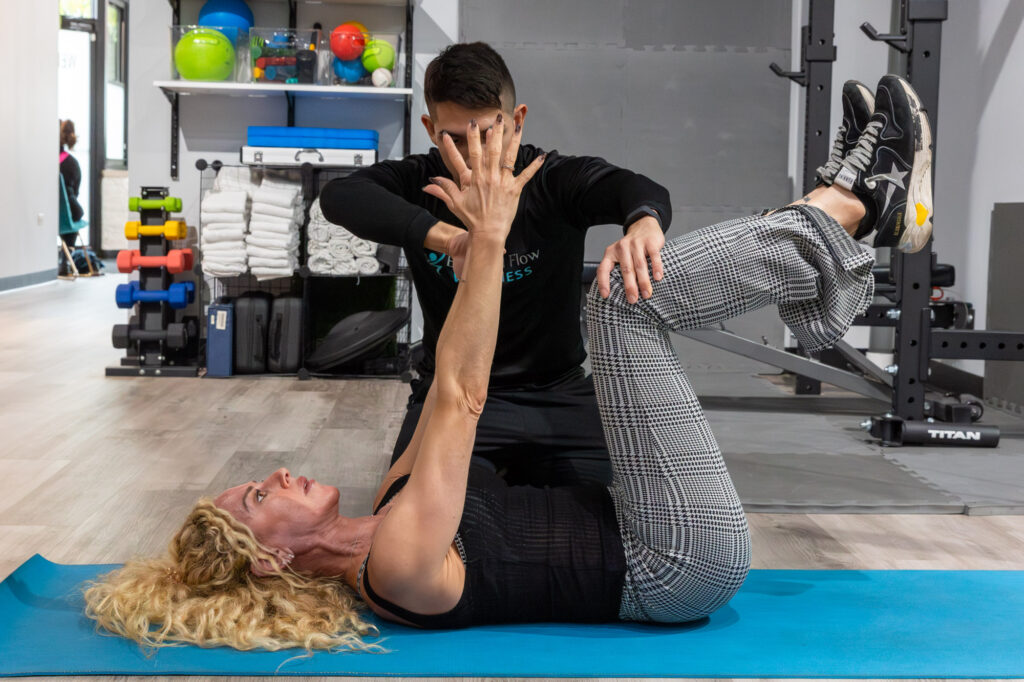
Most people judge their headaches by feel and by memory. We measure. We look at how your head sits over your shoulders, test the endurance of your deep neck flexors, check movement at the top of the neck and through the upper back, look for the trigger points that reproduce your familiar headache, and ask about old injuries like a whiplash that may have started the pattern.
Then we build the plan around what we find: hands-on work to restore movement where it’s missing, progressive training for the deep neck and shoulder blade muscles, and changes to the daily habits that keep loading the neck. We also give several types of injections at Balanced Flow, including trigger point injections, and we use them when the muscles aren’t responding to therapy the way they should or when we want to speed things up. They support the rebuild. They don’t replace it.
When is a headache an emergency?
Some headaches need urgent medical care, not neck treatment. Get help right away for a sudden, severe headache that peaks within seconds to a minute; a headache with fever and a stiff neck; a headache with weakness, numbness, confusion, trouble speaking, vision loss, or loss of balance; a headache after a blow to the head; or a new headache pattern after age 50, or one that keeps getting steadily worse. If your headaches have changed in character, see a physician before assuming it’s your neck.
The bottom line
Neck pain can absolutely cause headaches, and it contributes to many more. If your headaches start at the back of your head, favor one side, and flare with certain postures, your neck may be the driver. That’s good news, because a neck problem is something you can measure and fix.
If you’re in the Chicago area and your headaches keep coming back, we’ll check whether your neck is behind them and build a plan to change that. Book a consult and let’s find out.
Frequently asked questions
Where is a cervicogenic headache felt?
Typically on one side, starting at the back of the head or neck and spreading toward the top of the head, the temple, the forehead, or behind the eye. It’s often accompanied by neck stiffness on the same side.
Can bad posture cause headaches?
It can contribute. People with tension-type headaches tend to carry their heads further forward, and in research, a more forward head position has been linked to more frequent headaches. Posture is usually a sign of the underlying problem, weak deep neck muscles and a stiff upper back, which is what treatment targets.
Can a tight neck trigger a migraine?
Neck pain is very common in people with migraine and can be part of the attack itself. The neck doesn’t cause migraine, but an irritated neck may add to the overall load. Addressing it can help some people, alongside proper medical migraine care.
How long does it take for neck-related headaches to improve with treatment?
In the research, programs ran about six weeks, and improvements were still present a year later. Many people notice changes sooner, but lasting results come from rebuilding strength and control, which takes consistent work over weeks.
References
1. Jull G, et al. A randomized controlled trial of exercise and manipulative therapy for cervicogenic headache. Spine. 2002;27(17):1835-1843. doi:10.1097/00007632-200209010-00004
2. Fernández-de-las-Peñas C, et al. Trigger points in the suboccipital muscles and forward head posture in tension-type headache. Headache. 2006;46(3):454-460. doi:10.1111/j.1526-4610.2006.00288.x
3. Al-Khazali HM, et al. Systematic review and meta-analysis of Neck Disability Index and Numeric Pain Rating Scale in patients with migraine and tension-type headache. Cephalalgia. 2024;44(8):3331024241274266. doi:10.1177/03331024241274266
4. Ha WS, et al. Pain beyond the head: clinical implications of body pain in migraine and tension-type headache in a population-based study. The Journal of Headache and Pain. 2026;27(1). doi:10.1186/s10194-026-02334-x