
Short answer: The most reliable way to reduce neck pain naturally is to fix what keeps overloading your neck. For most people that’s a stiff upper back, small deep neck muscles that have stopped doing their job, and a head that has drifted forward of the shoulders. Targeted exercise, especially for those deep neck muscles, has the strongest research behind it. Heat, stretching, and massage can calm a flare, but on their own they don’t change why your neck keeps flaring.
In about twelve years of treating necks at Balanced Flow, the Chicago clinic I founded, I’ve watched the same loop play out again and again. A massage feels great. An ibuprofen takes the edge off. A new pillow helps for a week. Then the ache at the base of the skull is back, usually right when work gets busy. That isn’t because natural approaches don’t work. It’s because most people aim them at the spot that hurts instead of the thing that’s causing it.
How common is neck pain?
Very. The Global Burden of Disease study estimates that at any given moment about 3,550 out of every 100,000 people worldwide are living with neck pain, and the burden runs highest in wealthier, more desk-bound countries.1 It rarely makes headlines because it rarely threatens your life. It just quietly takes things: a full night’s sleep, focus in the afternoon, the ability to check your blind spot without turning your whole torso.
Why does my neck hurt in the first place?
Here’s the pattern I see in most people who walk in with a sore neck. We live in one direction. Sit, lean forward, look down at a screen, repeat for ten hours. Over months and years, the upper back stiffens into a forward curve. To see the monitor from inside that hunch, you crane your head up and forward. That one compensation changes the job description of every muscle in your neck.
The deep neck flexors, a set of small muscles along the front of your spine that hold your head stacked over your shoulders, get switched off. The bigger muscles at the back of the neck and across the tops of the shoulders pick up their work, and they never get to rest. That’s the tight traps, the knot at the base of the skull, the headache that creeps in by 3 p.m. The neck is where you feel it. The upper back and those quiet deep stabilizers are usually where it starts.
What are the most common causes of neck pain?
1. Forward head posture and a stiff upper back
Every inch your head drifts forward, the muscles behind it have to work harder to keep you from looking at the floor. Pair that with an upper back that no longer extends, and the neck has to do all the bending the upper back used to share. When researchers pooled 10 randomized trials of people with forward head posture and neck pain, targeted exercise improved head position, reduced pain, and improved neck function compared with no exercise, and programs that ran at least eight weeks and combined several types of exercise looked the most effective.5
2. Deep neck muscles that have gone quiet
This is the cause that gets missed most often, because nothing about it shows up on an X-ray or an MRI. The deep neck flexors are endurance muscles. They’re meant to hum along all day at low effort. When they stop working, the larger muscles take over a job they were never built to do continuously, and they get irritated, tight, and painful.
3. Breathing from your chest instead of your diaphragm
This one surprises people. When you slump, the diaphragm can’t move well, so you start breathing by lifting your rib cage instead. The muscles that do that lifting attach to your neck. That means every breath, thousands of times a day, recruits your neck to help. Almost nobody connects how they sit with how they breathe, and almost nobody connects how they breathe with why their neck is tight. The research here is early: a 2025 meta-analysis found that rehab programs adding breathing work improved head posture, though the effect on pain was limited and the overall evidence quality was low.7 I treat breathing as one piece of the puzzle, not the whole answer.
4. Old injuries and the compensations they leave behind
After a whiplash, a fall, or even a bad stretch of sleeping wrong, your body quietly rewrites how it moves to protect the sore area. That protective pattern often outlives the injury by years. It loads tissues that weren’t designed to take it, and the pain shows up somewhere new, sometimes as headaches, sometimes as a shoulder that won’t settle.
5. Disc and nerve irritation
Sometimes a disc or an irritated nerve root is part of the picture. The giveaway is pain, numbness, tingling, or weakness that travels into the arm or hand. That deserves a proper assessment, but even here, how you restore strength and mobility around the area largely determines whether you recover fully or trade it for a chronic problem.
How do you reduce neck pain naturally?
Strengthen the deep neck flexors
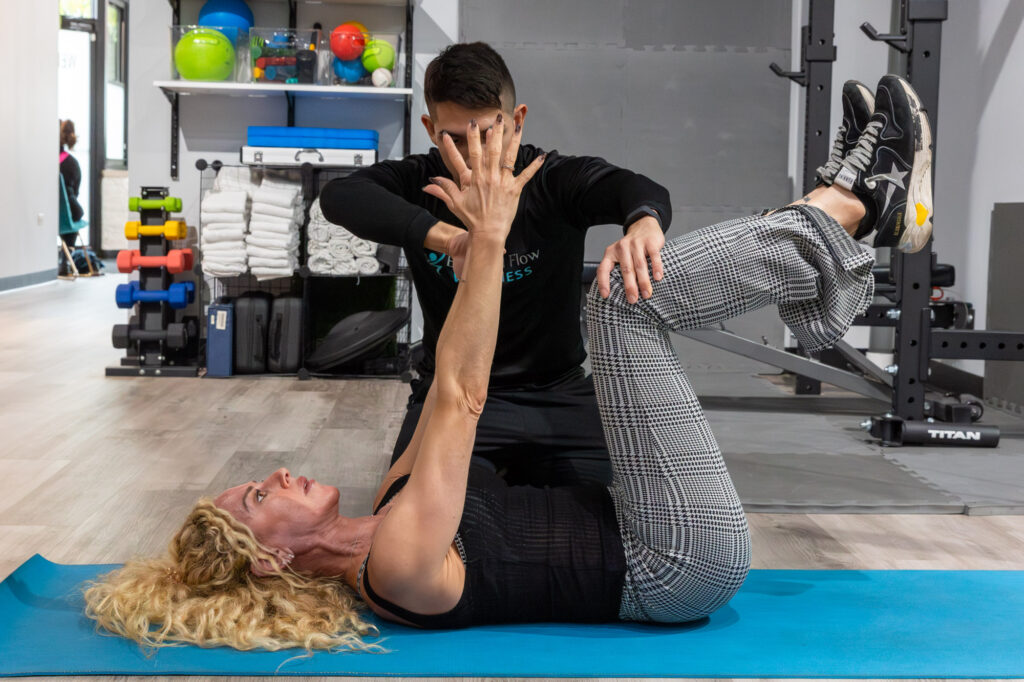
If I could give everyone with a chronically sore neck one exercise, it would be some version of the chin nod: lying on your back, gently nod as if saying “yes,” flattening the back of your neck toward the surface without lifting your head, and hold. It looks like nothing. Done properly and progressed over weeks, it’s one of the best-supported tools we have. A 2026 meta-analysis of 25 randomized trials and 1,166 people with chronic neck pain found that this kind of craniocervical flexor training produced a moderate-to-large drop in pain, and that combining it with other treatment produced an even bigger one.4 The authors flagged real variation between studies, so treat that as strong direction rather than a guarantee.
Make the exercise supervised and progressive
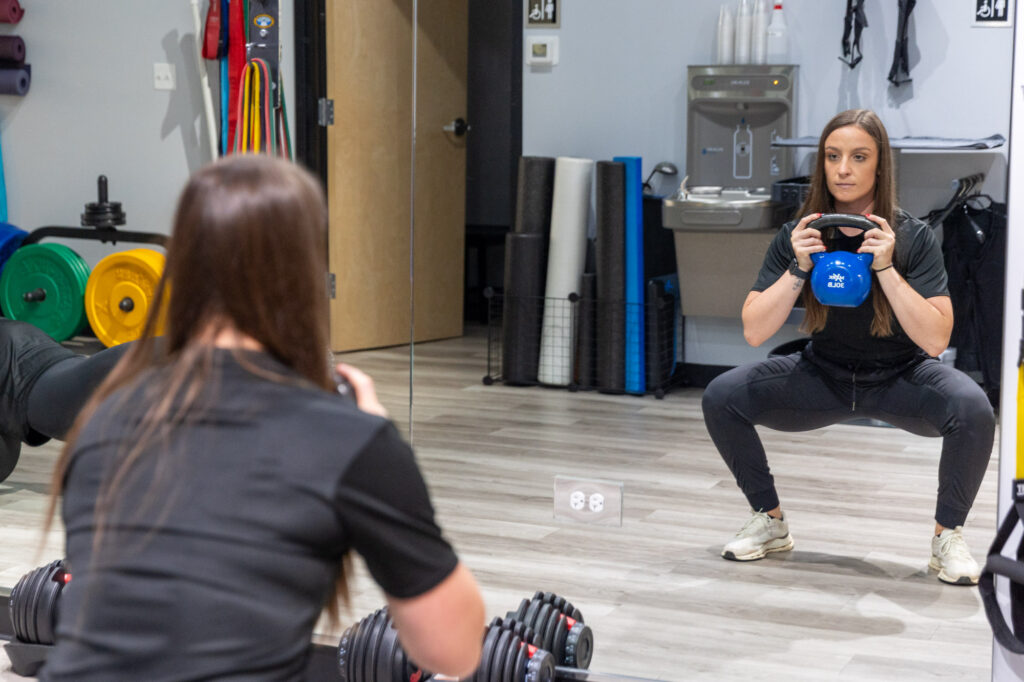
A printout of neck stretches is not a rehab program. In a randomized trial of 270 people with chronic neck pain, a supervised, progressive strengthening program produced better outcomes than home exercise with advice, especially over the first few months.3 Interestingly, adding spinal manipulation on top of the supervised strengthening didn’t change the results much. The strengthening was doing the heavy lifting.
Get the upper back moving again
Hands-on work to restore mobility through the upper back and neck has a real place, especially early. In a trial of 272 people with recent-onset neck pain, spinal manipulation outperformed medication for pain over a full year, and just a few sessions of home exercise with advice also beat medication at six months and kept pace with manipulation at most time points.2 The pattern is consistent: hands-on care and movement beat pills, and the gains last when you keep moving.
Retrain how you breathe
Learning to breathe low into the belly and lower ribs takes your neck off breathing duty. It’s simple to learn and hard to make automatic, which is why we practice it until it is.
Change the daily load
Raise the screen to eye level. Get up every 30 to 45 minutes. Look at how you sleep, because spending a third of your life in a position that strains the neck undoes a lot of good work. I go deeper on that in how to sleep with neck pain.
Is fixing my posture enough to fix neck pain?
Not on its own, and this is where a lot of neck advice goes wrong. A 2026 meta-analysis of randomized trials found that corrective exercise reliably improved postural angles in the head, shoulders, and upper back, but the benefits for pain and function were inconsistent.6 Looking better in a photo and working better are not the same thing.
Posture is a clue, not the target. The target is function: deep neck endurance, upper back mobility, shoulder blade control, how you breathe, and how well your neck tolerates the loads of your actual day. That’s why we measure those things directly instead of just telling you to sit up straight.
Do heat, massage, and stretching help neck pain?
Yes, for relief. Heat relaxes guarded muscles, massage calms them down, and gentle stretching feels good. I’m not against any of it. But relief is the easy part. We can take your pain away quickly. That was never the hard part, and it was never the fix. If the deep stabilizers are still off and the upper back still won’t move, the same muscles will be overworked again by Thursday.
Where do injections fit in?
We’re not opposed to injections at Balanced Flow. We give several types, including trigger point injections and regenerative options. We bring them in to facilitate physical therapy and when a neck isn’t responding the way it should, or when we want to speed up the rebuild. What we don’t do is treat an injection as the fix. A cortisone injection can quiet inflammation, but like a pill, it does nothing to change the mechanics that created the irritation. The work that keeps the pain from coming back is still the strength, mobility, and movement work.
How do we find the real cause of neck pain?
Most people judge their neck by feel. Feel is a bad instrument. So we measure. We look at where your head sits relative to your shoulders, test how long your deep neck flexors can hold, check how well your upper back extends and rotates, watch how your shoulder blades move when you reach, and look at how you breathe. It’s all a part of our 51-point full body functional evaluation. We ask about old injuries that may have started a compensation years ago.
The plan comes from what we find. Restore the mobility that’s missing, rebuild the endurance that’s gone quiet, retrain the pattern, and progress the load until your neck can handle your real life with room to spare. Done right, the result isn’t just less pain. It’s a neck that’s more capable than it was before.
When should I see someone about neck pain?
Get assessed promptly if your neck pain followed a fall, a car accident, or other trauma; if you have numbness, tingling, or weakness in your arms or hands; if you notice trouble with balance or coordination; if it comes with fever or unexplained weight loss; or if you have a sudden, severe headache unlike anything you’ve had before. Those need a medical evaluation, not a stretching routine.
And if your neck pain keeps coming back, that recurrence is the signal. Neck pain often travels with other symptoms too. If yours comes with headaches, read can neck pain cause headaches. If it comes with an off-balance, lightheaded feeling, read can neck pain cause dizziness.
The bottom line
Neck pain is rarely just a neck problem. It’s usually the end of a chain that starts with how you sit, how your upper back moves, and whether your deep neck muscles are still doing their job. Treat the ache and it comes back. Fix the chain and it usually doesn’t.
If you’re in the Chicago area and tired of managing the same neck pain every few weeks, that’s the problem we solve at Balanced Flow. We’ll measure what’s actually going on and build a plan that fixes it. Book a consult and let’s find the cause.
Frequently asked questions
What is the fastest natural way to relieve neck pain?
For quick relief, heat, gentle movement, and changing position every 30 to 45 minutes help most people. For lasting relief, the fastest route is targeted strengthening of the deep neck flexors combined with restoring upper back mobility, because that addresses why the neck is overloaded.
Can neck pain go away on its own?
A mild flare from sleeping wrong or a long day often settles in days. If it keeps returning, the underlying cause, usually weak deep neck muscles and a stiff upper back, hasn’t been addressed, and it will likely keep coming back until it is.
What exercises are best for neck pain?
Chin nods (craniocervical flexion) have some of the best research support, especially when progressed under supervision. Upper back extension and rotation work, shoulder blade strengthening, and breathing drills round out most programs.
Will a new pillow fix my neck pain?
A pillow can help, especially one that keeps your neck level, but it rarely fixes the problem on its own. Research suggests pillow height and shape matter more than material.
When is neck pain serious?
Neck pain after trauma, pain with arm numbness or weakness, problems with balance or coordination, fever, unexplained weight loss, or a sudden severe headache all warrant prompt medical evaluation.
References
1. Safiri S, et al. Global, regional, and national burden of neck pain in the general population, 1990-2017: systematic analysis of the Global Burden of Disease Study 2017. BMJ. 2020;368:m791. doi:10.1136/bmj.m791
2. Bronfort G, et al. Spinal manipulation, medication, or home exercise with advice for acute and subacute neck pain: a randomized trial. Annals of Internal Medicine. 2012;156(1 Pt 1):1-10. doi:10.7326/0003-4819-156-1-201201030-00002
3. Evans R, et al. Supervised exercise with and without spinal manipulation performs similarly and better than home exercise for chronic neck pain: a randomized controlled trial. Spine. 2012;37(11):903-914. doi:10.1097/BRS.0b013e31823b3bdf
4. Javdaneh N, et al. The effect of craniocervical flexor exercise on chronic neck pain: a systematic review and meta-analysis. Pain Management. 2026;16(10):1171-1181. doi:10.1080/17581869.2026.2694373
5. Xing Y, et al. Therapeutic Exercise for Forward Head Posture in Neck Pain Patients: A Systematic Review and Meta-Analysis. Journal of Pain Research. 2026;19:614524. doi:10.2147/JPR.S614524
6. Khorramroo F, et al. Corrective exercises strongly improve posture but fail to produce consistent clinical or functional benefits in patients with upper crossed syndrome: a systematic review and meta-analysis of randomized controlled trials. BMC Sports Science, Medicine and Rehabilitation. 2026;18(1). doi:10.1186/s13102-026-01707-8
7. Park S, et al. The Effects of Rehabilitation Programs Incorporating Breathing Interventions on Chronic Neck Pain Among Patients with Forward Head Posture: A Systematic Review and Meta-Analysis. Bioengineering. 2025;12(9):947. doi:10.3390/bioengineering12090947