
Short answer: The best way to sleep with sciatica is in a position that keeps your spine neutral and takes tension off the nerve. For most people that’s on your side with a pillow between your knees, or on your back with a pillow under your knees. Avoid lying flat on your stomach, and avoid positions that twist your pelvis. Then pay attention to the hour before bed, because how you sit and move in the evening often decides how bad the night gets.
In about twelve years of treating sciatica at Balanced Flow, the Chicago clinic I founded, I’ve heard a lot of people describe the same night: you finally fall asleep, roll over, and a jolt down your leg wakes you up. Or you can’t get comfortable at all and end up on the couch. Sciatica at night is miserable, and it wears you down fast. Here’s how to set yourself up for better nights while the bigger problem gets fixed.
Why is sciatica worse at night?
A few things stack up. Lying still for hours lets an inflamed nerve root stiffen and get more sensitive. Certain positions stretch or compress the nerve. And after a day of sitting, the disc that’s irritating the nerve has often been under load for hours before you even get into bed.
Then there’s the sleep itself. Losing sleep makes pain worse. A 2022 meta-analysis of 31 experimental studies found that cutting sleep lowered pain thresholds and tolerance and that broken-up sleep increased pain sensitivity in healthy people.2 The evidence in people who already live with chronic pain is less certain, but the practical takeaway is the same: a bad night makes tomorrow’s sciatica worse, and tomorrow’s sciatica makes the next night worse.
What is the best sleeping position for sciatica?
There isn’t much research on sleep positions for sciatica specifically. A scoping review on sleep posture and spinal symptoms found very few high-quality studies, though side lying was generally associated with less waking pain and stiffness.1 So treat the positions below as starting points, and let your leg tell you which one works.
On your side with a pillow between your knees
This is where I’d start. Lie on the side that doesn’t hurt, bend your knees slightly, and put a firm pillow between your knees and ankles. That keeps your top leg from dropping forward and twisting your pelvis and low back. Some people do even better curling into a gentle fetal position, which opens up space where the nerve roots exit the spine.
On your back with a pillow under your knees
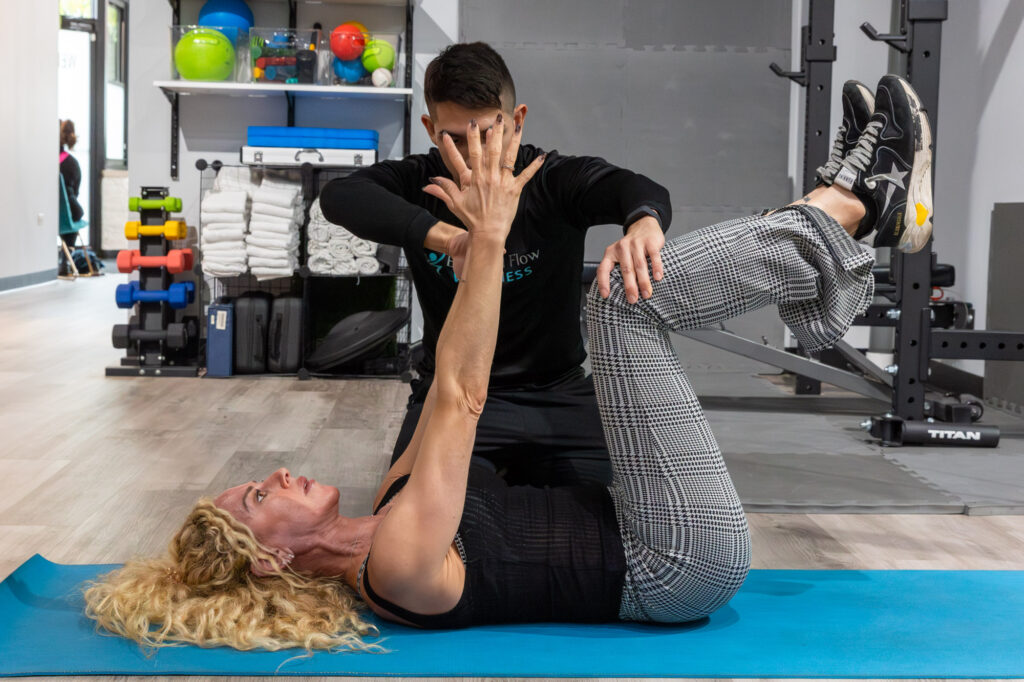
Bending your knees takes tension off the sciatic nerve, which runs down the back of the leg. A pillow or two under your knees lets you lie on your back without the nerve pulled taut. A small rolled towel under your low back can help if there’s a gap.
Should you sleep on your stomach with sciatica?
Usually not. Lying flat on your stomach tends to arch the low back and forces your head and neck to twist for hours. If it’s the only way you can fall asleep, a thin pillow under your hips and pelvis reduces the arch. Some people with disc-related sciatica find their leg pain eases when the low back is slightly extended, so if this is the one position that genuinely calms your leg, that’s useful information to bring to your clinician.
What if no position is comfortable?
Some nights, nothing works. When that happens, a few things are worth trying. A recliner or a stack of pillows that props you up with your hips and knees bent can take enough tension off the nerve to let you sleep. Getting up for a slow two-minute walk around the house can calm a nerve that has stiffened from lying still. And keeping a pillow arrangement in place for the whole night, rather than rebuilding it every time you wake, makes it easier to drift back off.
If you’re regularly unable to find any comfortable position, or the pain is severe and constant regardless of what you do, that’s not something to push through. Get it assessed.
How do I get out of bed without triggering sciatica?
Don’t sit straight up from your back. That’s a loaded bend through the exact discs that are irritated. Instead, roll onto your side with your knees bent, drop your feet off the edge of the bed, and push up with your arms as your legs go down. Reverse it to get into bed. It sounds like a small thing, but it removes two of the worst moments of the day.
What should I do before bed if I have sciatica?
The evening sets up the night. A few habits make a real difference.
Avoid a long stretch of slumped sitting right before bed. A couch session is often the worst thing for an irritated disc. Take a short, easy walk after dinner instead. Try a few minutes of gentle nerve glides, the kind I describe in how to relieve sciatica pain, rather than hard hamstring stretches that pull on the nerve. Heat on the low back or buttock for 15 to 20 minutes can relax guarded muscles. And set up your pillows before you lie down, so you’re not wrestling with them at 2 a.m.
Should I just stay in bed until it gets better?
No. Resting in bed feels like the safe choice, but it doesn’t help sciatica heal. In a randomized trial of 183 people with sciatica, two weeks of bed rest produced no better results than simply waiting it out without bed rest, both at two weeks and at three months.3 Sleep well at night, but keep moving during the day.
Why better sleep positions aren’t the whole fix
Good positioning takes pressure off the nerve for the night. It doesn’t change why the nerve is irritated. Most of the people I see with sciatica have a disc that’s been overloaded for years by long sitting, glutes that don’t fire, a stiff hip, and a core that isn’t supporting the spine. Until those change, the nerve keeps getting irritated during the day, and nights stay hard.
That’s the work that actually changes your sleep long term. I lay out the timeline and what drives recovery in how long does sciatica last.
When should I get my sciatica checked?
Get emergency care right away for new trouble controlling your bladder or bowels, numbness in the groin or inner thighs, or weakness in both legs. Get seen promptly if your leg weakness is getting worse, if pain wakes you no matter what position you’re in, or if sciatica comes with fever or unexplained weight loss. And if you’ve changed positions and pillows and your nights are still bad after a few weeks, the cause needs a proper assessment.
The bottom line
Sleep on your side with a pillow between your knees, or on your back with your knees supported. Get in and out of bed with a log roll, avoid slumped sitting before bed, and keep moving during the day. Those changes can make nights more bearable. Fixing what’s irritating the nerve is what makes them good again.
If you’re in the Chicago area and sciatica is wrecking your sleep, we can find out what’s driving it and build a plan to fix it. Book a consult and let’s get you sleeping again.
Frequently asked questions
Which side should I sleep on with sciatica?
Most people are more comfortable lying on the side that doesn’t hurt, with a pillow between the knees. If that’s still painful, try the other side or your back with your knees supported, and go with whichever one eases your leg.
Is a firm or soft mattress better for sciatica?
There’s no single answer. What matters is that your mattress lets you hold a neutral position without sagging into a twist. If you wake up stiffer than you went to bed every night, your mattress may be part of the problem.
Can sleeping wrong cause sciatica?
A bad night can aggravate an already irritated nerve, but sleep position rarely causes sciatica on its own. The underlying problem is usually a disc that’s been overloaded by daytime habits.
Why does my sciatica hurt more when I lie down?
Lying still for hours lets an inflamed nerve stiffen and get more sensitive, and some positions stretch or compress it. If lying down is consistently worse than moving, or pain wakes you no matter what position you’re in, get it checked.
References
1. Cary D, et al. Identifying relationships between sleep posture and non-specific spinal symptoms in adults: A scoping review. BMJ Open. 2019;9(6):e027633. doi:10.1136/bmjopen-2018-027633
2. Chang JR, et al. The differential effects of sleep deprivation on pain perception in individuals with or without chronic pain: A systematic review and meta-analysis. Sleep Medicine Reviews. 2022;66:101695. doi:10.1016/j.smrv.2022.101695
3. Vroomen PC, et al. Lack of effectiveness of bed rest for sciatica. New England Journal of Medicine. 1999;340(6):418-423. doi:10.1056/NEJM199902113400602