
Short answer: Yes, neck pain can cause dizziness. It’s called cervicogenic dizziness, and it usually feels less like the room spinning and more like being off-balance, unsteady, or slightly disconnected, especially when you move your head or hold your neck in one position. It happens because your neck is one of the main sources of information your brain uses to know where your head is in space. When that information gets scrambled, balance suffers. Because many other conditions cause dizziness too, the neck should only be blamed after those have been ruled out. When the neck is the driver, the research shows it’s very treatable.
In about twelve years of treating necks at Balanced Flow, the Chicago clinic I founded, I’ve seen plenty of people who were told their dizziness was “just stress” or who had normal results on every test and still felt off. Some of them had a neck that had been sending bad information to their brain for months. It’s one of the most underrecognized connections in the body.
How can neck pain cause dizziness?
Your brain builds its sense of balance from three streams of information: your inner ear, your eyes, and the sensors in your joints and muscles, especially in your neck. The upper neck is packed with these position sensors, and they’re wired directly into the systems that control balance and eye movement. Their job is to tell your brain exactly where your head is relative to your body.1
When the neck is painful, stiff, or injured, those sensors start sending distorted signals. Pain itself changes how the nervous system processes them, and muscle guarding changes the input further. Now your inner ear and eyes are saying one thing and your neck is saying another. The brain can’t fully reconcile the mismatch, and you feel it as unsteadiness, light-headedness, or a sense of being slightly off.
I explain it to patients this way: after an injury, your body’s internal map of itself can be wrong. If nobody retrains it, the faulty input persists, and you genuinely are less coordinated. You’re not imagining it. The map is off.
What does cervicogenic dizziness feel like?
It tends to have a recognizable pattern. The dizziness is more of an unsteady, floaty, or off-balance feeling than true spinning. It shows up alongside neck pain or stiffness, and it often rises and falls with it. It’s triggered or worsened by neck movements, turning your head, or holding one position for a long time, like working at a computer. It may come with a headache at the back of the head. And it often started after a neck injury such as whiplash, or developed alongside chronic neck pain.
What else could be causing my dizziness?
This is the most important section of this post. Cervicogenic dizziness is what clinicians call a diagnosis of exclusion, meaning other causes need to be ruled out first. Dizziness can come from the inner ear, blood pressure, medications, dehydration, heart rhythm problems, migraine, anxiety, and neurological conditions. One of the most common inner-ear causes produces brief, intense spinning when you roll over in bed or look up, and it’s treated very differently from a neck problem.
If you have dizziness, start with a medical evaluation. A good assessment for the neck happens alongside that, not instead of it.
When is dizziness an emergency?
Call 911 or get to an emergency room for dizziness that comes on suddenly with any of these: weakness or numbness on one side of the body, facial drooping, slurred speech or trouble understanding speech, double vision or vision loss, inability to walk or stand, a sudden severe headache, fainting, chest pain, or a racing or irregular heartbeat. Also get seen urgently if dizziness follows a head or neck injury. Those can signal a stroke, a heart problem, or a vascular injury, and every minute matters.
Can treating the neck fix the dizziness?
For true cervicogenic dizziness, the research is encouraging. In a double-blind randomized trial of 86 people with chronic cervicogenic dizziness, two different forms of hands-on manual therapy each reduced dizziness intensity and frequency compared with a placebo treatment, and the benefits were still present 12 weeks later.2 When the same researchers followed those patients for a full year, both manual therapy groups still had less frequent dizziness and less dizziness-related disability than the placebo group, with no adverse effects reported.3 A separate 2021 trial of 80 patients found similar results, along with better neck range of motion and some improvement in balance measures.4
There’s an important detail in that research. When the researchers looked specifically at balance and at how accurately people could reposition their heads, hands-on treatment alone made no clear difference, even though it improved neck movement.5 In other words, freeing up the neck reduced symptoms, but it didn’t automatically retrain the map. That’s why the most thorough approach pairs hands-on care with specific training of neck position sense, eye and head coordination, and balance. Researchers in this area argue that retraining the neck’s position sense deserves the same attention we give retraining the ankle after a sprain.1
How we treat dizziness that comes from the neck
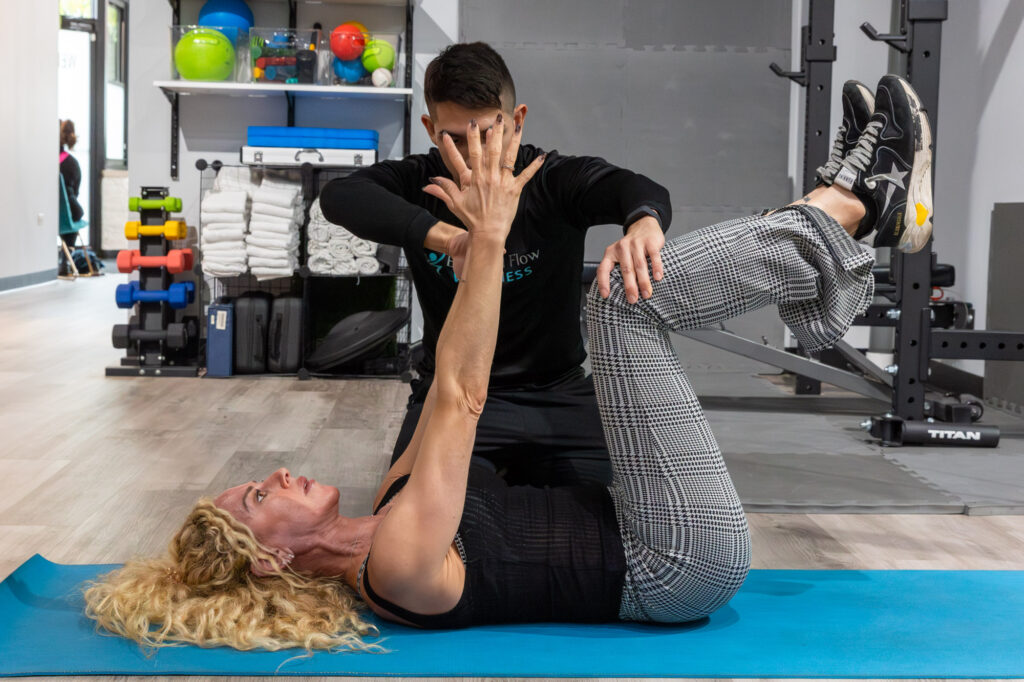
Once medical causes have been addressed, we measure. We check how accurately you can sense where your head is, how your eyes and head work together, how your balance holds up when your neck is turned, and how your neck moves. We look for the stiffness, weakness, and old injury patterns that started the problem.
Then we build the plan from what we find. Hands-on work restores movement in the upper neck. Specific drills retrain head position sense and eye-head coordination. Balance training rebuilds steadiness. And the same deep neck and upper back work that drives most neck pain recovery, which I cover in how to reduce neck pain naturally, takes the ongoing strain off. When headaches come along with the dizziness, which is common, we address both. You can read more about that in can neck pain cause headaches.
What can I do on my own?
Start by getting checked medically, and stop if anything you try makes the dizziness worse. Beyond that, the same habits that calm an irritated neck help here: break up long stretches at the screen, raise your monitor to eye level, keep your neck level at night (more in how to sleep with neck pain), and gently keep your neck moving within a comfortable range. Specific position-sense and balance drills are worth learning from a clinician, because doing them at the right level makes the difference between retraining the system and just provoking symptoms.
The bottom line
Neck pain can cause dizziness, usually an unsteady, off-balance feeling tied to neck movement and stiffness. It deserves a proper medical workup first, because dizziness has many causes and some are serious. But when the neck is the source, it’s very treatable, and the best results come from both freeing up the neck and retraining the balance system it feeds.
If you’re in the Chicago area and have been living with dizziness and neck pain that nobody has connected, that’s something we look at closely at Balanced Flow. Book a consult and let’s find out whether your neck is behind it.
Frequently asked questions
Can a stiff neck make you feel off-balance?
Yes. The neck sends your brain constant information about where your head is. When it’s stiff or painful, that information can be distorted, which can leave you feeling unsteady or slightly off, especially when you turn your head.
How do I know if my dizziness is from my neck?
Neck-related dizziness usually comes with neck pain or stiffness, rises and falls with it, and is triggered by neck movement or sustained postures. It’s typically unsteadiness rather than spinning. Because other causes are common, it should be confirmed only after a medical evaluation rules them out.
Can anxiety from neck pain cause dizziness?
Anxiety can cause dizziness on its own, and living with chronic pain and dizziness can increase anxiety. That’s one more reason to get a thorough assessment, so each piece is identified and addressed.
How long does cervicogenic dizziness take to improve?
In clinical trials, people received two to six treatments over about six weeks, and improvements held at 12 weeks and up to a year. Timelines vary with how long the problem has been present and how much retraining the balance system needs.
References
1. Treleaven J. Sensorimotor disturbances in neck disorders affecting postural stability, head and eye movement control. Manual Therapy. 2008;13(1):2-11. doi:10.1016/j.math.2007.06.003
2. Reid SA, et al. Comparison of Mulligan sustained natural apophyseal glides and Maitland mobilizations for treatment of cervicogenic dizziness: a randomized controlled trial. Physical Therapy. 2014;94(4):466-476. doi:10.2522/ptj.20120483
3. Reid SA, et al. Manual therapy for cervicogenic dizziness: Long-term outcomes of a randomised trial. Manual Therapy. 2015;20(1):148-156. doi:10.1016/j.math.2014.08.003
4. Micarelli A, et al. Postural and clinical outcomes of sustained natural apophyseal glides treatment in cervicogenic dizziness patients: A randomised controlled trial. Clinical Rehabilitation. 2021;35(11):1566-1576. doi:10.1177/02692155211012413
5. Reid SA, et al. Effects of cervical spine manual therapy on range of motion, head repositioning, and balance in participants with cervicogenic dizziness: a randomized controlled trial. Archives of Physical Medicine and Rehabilitation. 2014;95(9):1603-1612. doi:10.1016/j.apmr.2014.04.009